The Ultimate Guide to Icon Packs: Why the Document Archive Icon Set is a Designer's Essential Tool
In the digital world, where attention is scarce and clarity is paramount, visual communication reigns supreme. At the heart of this communication are icons—those small, symbolic images that guide users, convey ideas instantly, and elevate design aesthetics. While we encounter them daily on our apps and websites, the power of a well-crafted icon set is often underestimated. This article explores the significance of professional iconography and delves into how a specialized collection, like a Document Archive Icon Pack, becomes an indispensable asset for creators across fields.
Icons: More Than Just Decorative Graphics
Before understanding a specific pack, it’s crucial to grasp what icons are fundamentally meant to do. An icon is a visual metaphor. It translates a concept, action, service, or object into a simple, recognizable graphic. A good icon reduces cognitive load; it allows a user to understand function without reading text. Think of the universal "save" floppy disk symbol or the "upload" arrow. This immediacy is why icons are foundational to user interface (UI) and user experience (UX) design. They are not mere decoration; they are functional elements that facilitate interaction and comprehension.
The Rise of Niche Icon Sets
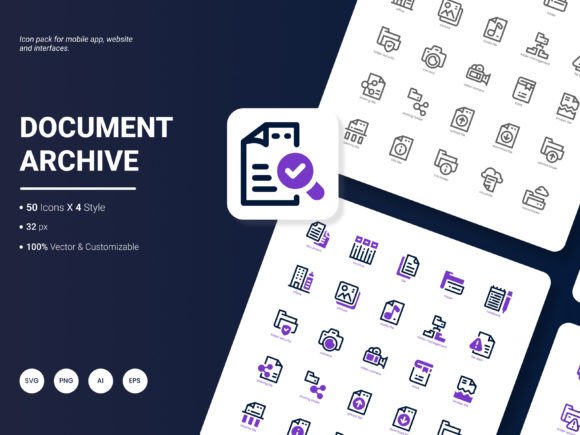
As digital projects have become more specialized, generic icon collections often fall short. Designers and content creators need visuals that speak directly to their project's theme. This is where niche icon packs, such as a Document Archive Icon Pack, come into play. This set isn't just a random assortment of symbols; it’s a curated library of 200 stylish icons focused on popular services and ideas related to documents, archives, data, and knowledge management. It answers a specific need, providing relevant imagery that generic sets might lack.
For instance, while a general pack might have a basic folder icon, a document archive-specific pack would include icons for cloud storage services, specific file types (like PDF or AI), archival seals, analytical charts, and presentation concepts. This specificity ensures that the visual language is consistent and deeply aligned with the project's subject matter, making the final design more coherent and professional.
Exploring the Document Archive Icon Pack: A Toolkit for Modern Creators
Let’s break down what makes such a pack not just useful, but essential. The described Document Archive Icon Pack comprises 200 trendy icons, available in six versatile formats and four distinct styles. But these numbers represent real practical benefits.
Versatility Across Formats and Applications
The offering of multiple file formats—AI, EPS, SVG, PNG, PDF, JPG—is a critical feature. Each format serves a different purpose in the design workflow:
- AI & EPS: These are vector formats, essential for professional design software like Adobe Illustrator. Vector icons are scalable to any size without losing quality, making them perfect for large-format prints like billboards or tiny mobile app buttons.
- SVG: This web-friendly vector format is ideal for modern website and app development. It ensures icons look sharp on any screen resolution and allows for dynamic styling with CSS.
- PNG & JPG: These raster formats are useful for quick placement in presentations, documents, or where simple image files are required. PNG offers transparency, crucial for overlaying icons on various backgrounds.
- PDF: Useful for standardized viewing and quick client previews without needing specialized design software.
This multi-format approach means the pack is truly flexible, ready for integration into website design, mobile applications, presentations, analytical reports, infographics, and templates without technical hindrance.
The Power of Editability and Style Variation
The "editable" feature is a game-changer. Unlike static images, editable vector icons allow designers to modify colors, shapes, and details to match their brand's exact palette and style. You can ungroup elements, change a blue document to your corporate green, or adjust line weights. This transforms the pack from a fixed product into a creative raw material.
Furthermore, having four different styles within the same thematic pack provides immense creative flexibility. A project might require a sleek, minimalist style for a fintech app, a more detailed, playful style for an educational infographic, or a bold, filled style for a presentation slide. With multiple styles included, you can maintain thematic consistency while adapting the visual tone to suit different contexts or audiences within the same project.
Practical Relevance in Business, Education, and Daily Life
The applications of a focused icon pack extend far beyond just "making things look nice." They play a functional role in enhancing communication and efficiency.
For Business & Analytics
In business environments, clear communication of data and processes is vital. An analytical report filled with dense text can be overwhelming. Integrating icons for concepts like "growth," "market analysis," "risk," "data flow," or "quarterly review" creates visual anchors that make reports easier to scan and understand. Presentations to stakeholders become more engaging when slides use consistent, professional icons to symbolize services like "cloud backup," "client portfolio," or "secure archive." This not only improves comprehension but also projects a brand image of modernity and attention to detail.
For Education & Creativity
Educators and content creators can use these icons to build more effective learning materials and infographics. An infographic about historical document preservation, for example, can use icons for "library," "digitization," "manuscript," and "cataloging" to break down complex information into digestible visual chunks. Tutorials or templates for website creation can use these icons as placeholders or design elements, speeding up the prototyping process and providing learners with high-quality visual resources.
For Technology & Website Design
In UI/UX design, consistency is law. Using a unified set of 200 icons covering related topics means a designer can build an entire interface for a document-management SaaS product, a digital library, or a research platform without scrambling to find matching icons from disparate sources. This consistency directly improves the user's experience, making the interface intuitive and trustworthy. The SVG format ensures perfect display on all devices, a non-negotiable requirement in today's multi-screen world.
Clarifying Common Misunderstandings
Two major assumptions often hinder the adoption of professional icon packs. First is the belief that "icons are easy to make, so why buy a pack?" While a simple icon can be drawn, creating 200 stylistically consistent, professionally balanced, and conceptually clear icons is a massive undertaking requiring significant design skill and time. A premium pack offers that value instantly.
The second is the idea that "using any icon you find online is fine." This overlooks licensing and quality issues. Many online icons are not licensed for commercial use, have inconsistent styles, or are low-resolution. A professionally sourced pack like this provides clear licensing for commercial projects, guaranteed quality, and design cohesion, protecting you from legal and aesthetic pitfalls.
Building a Broader Understanding: Icons as Part of Your Visual Language
Investing in a specialized icon pack is more than a purchase; it's a strategic decision to enhance your visual communication toolkit. It signals a commitment to quality, consistency, and user-centric design. Whether you are a freelance designer, a business analyst, a marketing professional, or an educator, having a ready library of editable, multi-format, theme-specific icons empowers you to communicate complex ideas with simplicity and style. It streamlines your workflow, elevates your projects, and ensures your visual content is as fresh and trendy as the ideas you are presenting.
Looking Forward: Suggestions for Future Updates
To keep such a valuable tool at the cutting edge, consider expanding it based on evolving digital trends. Future updates could include:
- Icons for emerging concepts like data privacy seals, blockchain-based verification, AI-assisted research, or collaborative editing workflows.
- More dynamic or animated SVG variants for interactive web applications.
- Icon variations tailored for specific industries (e.g., legal document icons, medical research archive icons).
- Integration with popular design systems like Figma libraries or WordPress icon plugins for even easier implementation.
- A "builder" kit with base shapes allowing users to mix and match elements to create custom hybrid icons within the archive theme.
By continuously aligning with user needs and technological advancements, a Document Archive Icon Pack can remain not just a collection of images, but a living, essential component of the digital creator's toolbox.