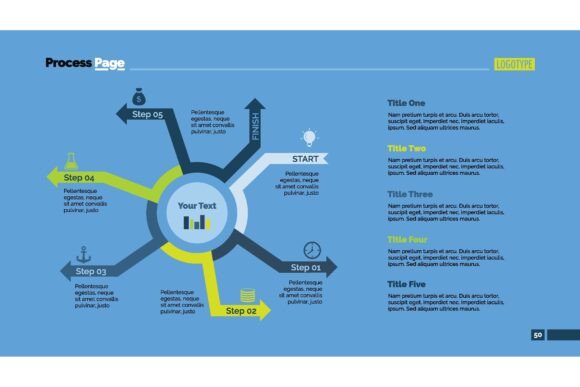
Five-Step Process Chart Slide Template
In a world overflowing with information, the challenge is often not in finding data, but in making it understandable and actionable. For anyone who needs to communicate a sequence, a strategy, or a workflow, visual clarity is paramount. This is where a tool like the five-step process chart slide template becomes indispensable. It is a pre-designed visual framework, typically built around five interconnected elements—often represented by circles, arrows, or clean diagrammatic shapes—that allows you to map out any linear progression in a clear, professional format.
At its core, the five-step process chart slide template is a bridge between raw information and audience comprehension. It’s more than a collection of shapes; it’s a structured canvas for synthesizing complex topics into a digestible narrative. Whether you’re explaining a new company policy, training a team on a software rollout, or pitching a project timeline, this template provides the skeleton for your story.
Why This Template Resonates Across Diverse Audiences
The value of a streamlined visual tool isn’ universal in a one-size-fits-all sense; it’s universal because it adapts to vastly different needs. What you prioritize in a template depends entirely on your role, your immediate goal, and your skill level. A marketer might see it as an engagement device, while a project manager views it as an analytical tool. An educator values its instructional clarity, and a beginner appreciates its guiding structure.
For the entrepreneur or small business owner, time is scarce and presentations carry weight. They might evaluate the five-step process chart slide template based on speed and commercial value. Can it quickly turn a business plan’s phases into a compelling investor slide? Does it help articulate a customer onboarding journey to clients? Their use is pragmatic: a means to communicate strategy efficiently and gain traction.
Educators and trainers, on the other hand, prioritize learning value and clarity. They might use the template to break down a complex scientific process into five manageable stages for students, or to outline a professional development program’s modules. For them, the template’s reliability and logical flow are key—it must visually reinforce the learning path without introducing confusion.
The Creator's Lens: Flexibility and Creative Stimulus
Bloggers, content creators, and freelancers often operate where aesthetics meet information. They care deeply about flexibility and creativity. A rigid, ugly template is a dead end. The described template, with its "streamlined circles and meticulous diagrams," acts as a creative stimulus. A blogger might use it to illustrate a 5-step recipe or a personal growth journey in an article. A freelance designer might adopt it as a base to create branded infographics for a client’s social media campaign. Their evaluation hinges on whether the template feels like a starting point for their unique voice, not a restrictive cage.
Consider a marketer crafting a campaign explainer. They could populate the five steps with: Awareness, Interest, Decision, Action, and Loyalty. The template visually structures the customer funnel, making the strategy tangible for the team. For a non-profit coordinator, the same circles might outline the steps of a community initiative: Planning, Recruitment, Execution, Assessment, Reporting. The template brings order to the mission.
Practical Priorities: From Beginners to Professionals
A beginner—perhaps a hobbyist starting a podcast or a new manager—likely prioritizes ease of use and learning value. They don’t want to spend hours learning design software. A well-built five-step process chart slide template should be intuitive: drag, drop, label, and customize colors. It serves as a safe entry point into visual communication, reducing the intimidation of a blank slide. Their project might be a personal timeline for a home renovation, shared with family.
An experienced professional, like a management consultant or data analyst, looks for quality, reliability, and long-term usefulness. Is the design sophisticated enough for executive boardrooms? Does it integrate seamlessly with standard presentation software? Can it accurately represent nuanced strategic discussions, like a mergers & acquisitions process or a data analytics pipeline? They use the template not as a crutch, but as a robust tool to elevate complex management analytics, ensuring every arrow and node conveys precise meaning.
Identifying Your Own Fit
How do you know if focusing on a five-step process chart slide template matches your needs? Ask yourself a few practical questions. Are you frequently needing to explain a sequence or workflow? Is your current method—long paragraphs, disjointed bullet points—failing to engage your audience? Do you lack the time or design confidence to build such frameworks from scratch?
If your goals involve clarifying instructions, presenting strategies, training teams, or creating informative content, this template is likely a relevant tool. Evaluate it against your primary constraint: if it’s time, look for speed; if it’s skill, prioritize ease of use; if it’s impact, judge its design quality and professional feel. A hobbyist documenting a crafting process can use a simpler iteration, while a corporate trainer might need the full "graphic marvel" to demonstrate organizational proficiency.
The true power of such a template lies in its concise visual communication. It forces distillation of ideas into their essence, which benefits both the creator and the viewer. For the project lead, it crystallizes thought; for the audience, it accelerates understanding. In meetings, workshops, or published content, it becomes the silent facilitator of consensus and clarity.
Ultimately, the five-step process chart slide template is a versatile ally in the modern need to inform and persuade. It meets the designer where data meets design, but it serves the user wherever explanation meets expectation. By adapting to the priorities of the person using it—whether those priorities are creative, educational, analytical, or purely practical—it transcends being a mere slide and becomes a fundamental instrument for narrative and insight.